By: Liz Strait, PhD
Introduction
Since the advent of COVID-19-related lockdowns, individual investors have started trading in short-term options at an unprecedented rate—with approximately 46 million contracts trading each day in the past year. These options, known as 0DTE (zero days to expiration), expire in 24 hours or less. With the widespread advent of commission-free trading, a surge of investors (particularly Millennials and Gen X), have entered the short-term trading fray—taking on large risks in the process. Many of these investors see 0DTE options as gambling rather than investments, but gambling and investment risks are not treated identically by individuals. For this reason, it is important for Financial Professionals (FPs) to understand how, from a client’s perspective, gambling in financial markets is different from investing in them. There are specific behavioral biases that can become more prominent with gambling risk (versus investment risk) and remaining oblivious to these behaviors will only hurt clients. While not every client may be interested in the topic or trading of short-term options, the biases and behavioral finance insights discussed are relevant for any clients who may view investing as similar to gambling.
Background
The realm of short-term options trading is vast and multifaceted. The intricacies and nuances of this topic make it worth revisiting despite one's acumen. The aim of this post isn't to oversimplify or reiterate what many FPs already know, but rather to provide a comprehensive overview, perhaps shedding light on some aspects that might not be regularly encountered in day-to-day advisory roles. This section will serve as a refresher for those already well-versed in short-term options trading, and as an introduction for FPs newer to the field or those who have not been exposed to 0DTE options.
Options
Options are contracts that give holders the option to buy or sell shares of an underlying asset at a specified price and time. Options are financial derivatives—they hold no value on their own, but rather derive their value from the underlying asset to which the contract is tied. Options can be based on stocks, indexes, debt/credit instruments, or foreign currency. Options trading is not new or revolutionary—standardized options contracts were introduced by the Chicago Board Options Exchange (CBOE) in 1973. However, options trading has grown both more popular and more complex since then, with new option types and derivatives being introduced as financial markets evolve.
Generally, options allow, but do not obligate, a holder to buy or sell an underlying asset at a preset price (the strike price) by a specified time (the expiration date). Investors can purchase options for a premium (e.g.,$5 per share)—this is what they pay regardless of whether they exercise the option. There are two general types of options: call and put.
- Call options give the holder (in this case, the buyer) the right to buy an asset at a specified (strike) price within a stated time frame (by the expiration date). Traders should purchase call options when they believe the price of the asset is going up within the time frame specified; then they can buy for the (lower) strike price, pocketing the difference between the strike price and the actual price minus the premium paid.
- Put options give the holder (in this case, the seller) the right to sell an asset at a specified (strike) price within a specified time frame (the expiration date). Traders should purchase put options when they believe the price of the asset is going down within the time frame specified; then they can sell for the (higher) strike price, pocketing the difference between the strike price minus premium paid and the actual price.
Figure 1
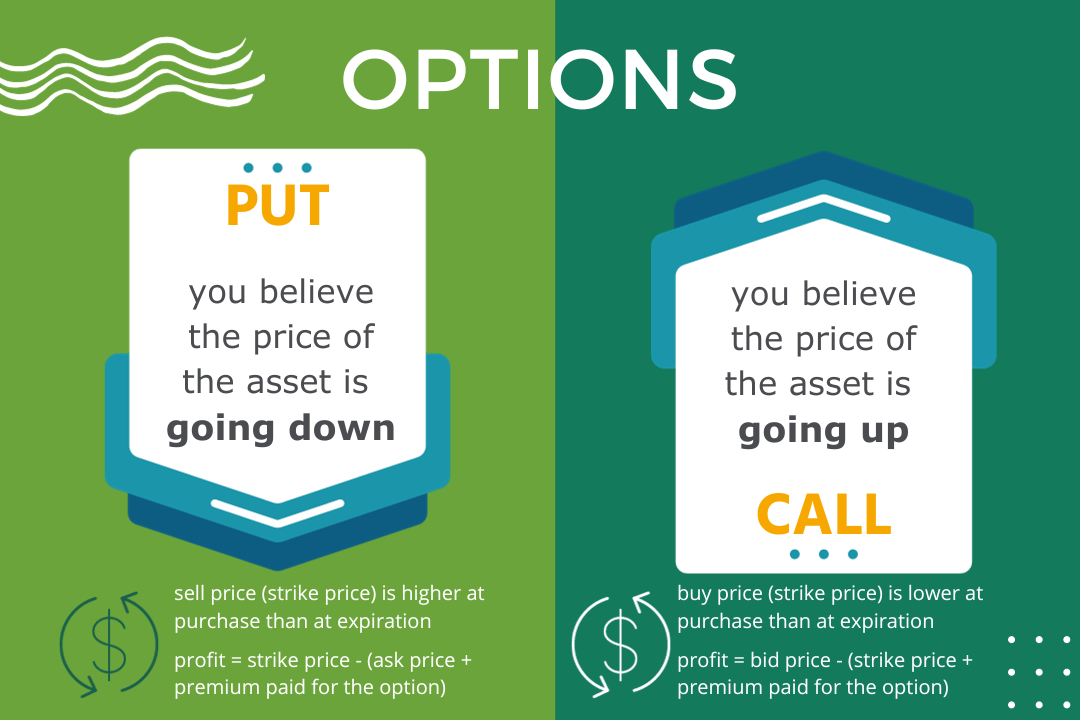
There are two general types of options contracts—put and call. Traders purchase put options if they believe the price of the asset (from which the option is derived) is going to go down; they purchase call options if they believe the price of the asset will go up.
The downside of options is that they become worthless upon their expiry. To hold an option, investors must pay for them, the amount paid is called the premium. If options expire and they aren’t exercised (because they aren’t “in the money”), the holder loses the premium paid. Consider the example below:
Investor W has $5,000 to invest. She anticipates an increase in the market price of ABC stock, which is currently priced at $50 a share, so she considers a 0DTE option. The premium for an ABC 50 call is $5 per share and each call covers 100 shares of ABC, so one ABC 50 call costs $500. Investor W uses her $5,000 to buy 10 ABC 50 calls. (Note: it’s a call option because the investor expects the price of ABC stock to increase and the “50” refers to the strike price—if the price of the share was $65, then it would be an ABC 65 call.) Because Investor W paid a $5 premium for each share, she will only profit if the price of ABC stock exceeds $55 before it expires (strike price + premium) when she exercises it (before or at expiration). Even if the stock price increases from $50 to $54, Investor W still loses $1,000 (($55 – 50) x 100 x 10 = $5,000 vs. ($54 - $50) x 100 x 10 =$4,000). However, if the price goes up significantly, say to $58 or $62, then Investor W makes a large return—$3,000 (+60%) or $7,000 (+140%), respectively.1
From the example above, the stock price must increase significantly (more than 10%) in the specified time, and this must happen by expiry, or the investor must time the market extremely well—perfectly to maximize their return.2 For short-term options, such as 0DTE, these requirements for profitability become even less likely because of the time constraint. Now this asset price increase must happen in a very short amount of time (i.e., there must be a lot of volatility in a matter of hours), and the investor can miss out on optimal timing in a matter of seconds. Further, the less time there is to expiration, the less time value there is. If there is time prior to expiration, the investor could sell the option to another holder for more than its original premium, even though exercising it would be worthless at that point in time. The shorter the expiration timeline, the less likely it is a holder can find someone willing to buy their option before expiry.
All of this is to say, the shorter the expiration time the riskier the option is. The investor is virtually betting on the market being extremely volatile and their ability to accurately predict the direction and timing of that volatility. Unsurprisingly, this is why most individuals investing in 0DTE options lose money. This is also why purchasing 0DTE options is likened to gambling—the short timeframe to expiration means the main objective is unlikely to be hedging, but rather a desire to make a high return in a short amount of time.3 One investor described 0DTE trading as having unlimited upside4 while another stated, “Other than a casino, there’s nowhere else you can get a return like that”5—which, at least anecdotally, speaks volumes about the motivation underlying 0DTE options trading.
The Home-Trading Boom
Individual investors started flocking to short-term options trading with the initiation of COVID-19 lockdowns. Suddenly, people found themselves stuck at home with more time to vigilantly monitor the stock market. Importantly, this also somewhat coincided with the change to commission-free trading—Schwab, TD Ameritrade, E*Trade, and Fidelity all followed Robinhood’s lead by the end of 2019.6 This reduced the average cost (fees + commission) for options from approximately $6 per contract to $0.657, making the barriers to entry much lower. And this has been demonstrated in dramatic average daily volume surges—the average daily volume of 0DTE contracts has increased 300% from January 2022 to March 2023, topping out at 1.2 million contracts according to OptionMetrics.
Figure 2

Source: Cboe (Sep 2023)
However, individual investors underperform the broader market on average because of excessive trading, which is exacerbated by short-term options contracts.8 In general, most individual investors trading in options lose money—between the end of 2019 and June 2021, options traders lost approximately $2.1 billion, with the losses concentrated in options with shorter dates.9 With volatility in the market, individual investors have been increasingly drawn to short-term options, since increasing volatility offers the chance at even higher rewards (and even higher risk). Ultimately, it seems that “free trading” has only served to lure novice traders into making extremely risky trades without realizing it.
Atlas Point
Ready to unlock valuable behavioral insights on this topic? Subscribers on the Atlas Point platform enjoy these exclusive benefits:
- Behavioral insights regarding the topic covered in this blog
- Personalized behavioral analytics tailored to your business - Identify clients most concerned with just a click
- Learn effective communication strategies for clients worried about this issue
Not a subscriber yet? Contact us (redirect to book a demo page) to learn how to access these exclusive behavioral insights.
Subscribers, click here to read the full article and stay ahead of the curve.
End Notes
[1] This example was adapted from Robinhood’s extensive document, “Characteristics and Risks of Standardized Options” (March 2023). Robinhood states, “Customers must read and understand the Characteristics and Risks of Standardized Options before engaging in any options trading strategies.” A PDF of this document is available here and is recommended for anyone who wants to understand options and their risks in more detail.
[2] In this example (and throughout this post), it is assumed the options are American-style (vs. European-style) and that holders can exercise their contract at any time up to and including the expiration point. European-style options can only be exercised, if desired, at expiration.
[3] Investors, particularly institutional investors, use options to hedge their investments in an asset. If there is high volatility, investors holding the underlying asset may also purchase options on the asset to manage their risk exposure. For very short-term options, this risk mitigation strategy does not make sense—the risk of the options is too high to justify its use for hedging.
[4] Banerji, Gunjan. “Amateurs Pile Into 24-Hour Options: ‘It’s Just Gambling’.” The Wall Street Journal, 12 Sep 2023, https://www.wsj.com/finance/stocks/options-individual-investors-risk-gambling-a97bee1a.
[5] Banerji, Gunjan, and Alexander Osipovich. “Free Trades, Jackpot Dreams Lure Small Investors to Options.” The Wall Street Journal, 24 Jun 2020, https://www.wsj.com/articles/free-trades-jackpot-dreams-lure-small-investors-to-options-11592991000.
[6] This isn’t to say these brokers lost money. Brokerages made in excess of $2 billion on options orders in 2022. This is over two-fold what they made from stock orders. This is because they can capitalize on the wider bid-ask spreads associated with options. See: Banerji, Gunjan. “Amateurs Pile Into 24-Hour Options: ‘It’s Just Gambling’.” The Wall Street Journal, 12 Sep 2023, https://www.wsj.com/finance/stocks/options-individual-investors-risk-gambling-a97bee1a.
[7] Royal, James. “Zero-Fee Broker Commissions: Here’s Who The Big Winner Is.” Bankrate, 4 Oct 2019, https://www.bankrate.com/investing/zero-fee-broker-commissions-long-term-investors-win/.
[8] Odean, Terrance. “Do Investors Trade Too Much?” The American Economic Review, 89(5), December 1999, pp. 1279–98, doi:10.1257/aer.89.5.1279. Accessible here: http://faculty.haas.berkeley.edu/odean/papers%20current%20versions/doinvestors.pdf.
[9] Bryzgalova, Svetlana and Pavlova, Anna and Sikorskaya, Taisiya, "Retail Trading in Options and the Rise of the Big Three Wholesalers." Journal of Finance forthcoming. Available at SSRN: https://ssrn.com/abstract=4065019 or http://dx.doi.org/10.2139/ssrn.4065019.
[10] Lopes, Lola L. “Between Hope and Fear: The Psychology of Risk.” Advances in Experimental Social Psychology, Elsevier, 1987, pp. 255–95, http://dx.doi.org/10.1016/s0065-2601(08)60416-5.
[11] Camerer, Colin F. “Prospect Theory in the Wild: Evidence from the Field.” Choices, Values, and Frames, eds. Daniel Kahneman and Amos Tversky, Cambridge University Press, 2000, pp. 288–300.
[12] Individuals struggle to comprehend extreme probabilities, so extremely unlikely outcomes tend to be overweighted (or ignored—though this response is irrelevant for this discussion as clients who ignore extremely low probabilities of a positive outcome would be unlikely to show an interest in 0DTE options trading).
[13] Thaler, Richard H., and Eric J. Johnson. “Gambling with the House Money and Trying to Break Even: The Effects of Prior Outcomes on Risky Choice.” Management Science, No. 6, June 1990, pp. 643–660, doi:10.1287/mnsc.36.6.643.